Youth2030 Progress Report 2026
Evaluates the system-wide progress of the UN Youth2030 strategy, detailing efforts to ensure meaningful youth engagement is embedded in global decision-making.

Evaluates the system-wide progress of the UN Youth2030 strategy, detailing efforts to ensure meaningful youth engagement is embedded in global decision-making.
The Ombudsman for Children’s Office (OCO) is an independent statutory body, which was established in 2004 under the Ombudsman for Children Act 2002 (2002 Act). Under the 2002 Act, as amended, the OCO has two core statutory functions:
to promote the rights and welfare of children up to 18 years of age; and
to examine and investigate complaints made by or for children about the administrative actions of public bodies, schools and voluntary hospitals that have, or may have, adversely affected a child.
This briefing is third in a series that the OCO is producing to raise awareness of children’s rights under the United Nations Convention on the Rights of the Child (UNCRC).1 We are creating this series in line with our duties:
to encourage public bodies to develop policies, practices and procedures designed to promote the rights and welfare of children (section 7(1)(b) of the 2002 Act); and
to collect and disseminate information on matters relating to children’s rights and welfare (section 7(1)(c) of the 2002 Act).
The Ombudsman for Children’s Office (OCO) is an independent statutory body, which was established in 2004 under the Ombudsman for Children Act 2002 (2002 Act). Under the 2002 Act, as amended, the OCO has two core statutory functions:
to promote the rights and welfare of children up to 18 years of age; and
to examine and investigate complaints made by or for children about the administrative actions of public bodies, schools and voluntary hospitals that have, or may have, adversely affected a child.
This briefing is second in a series that the OCO is producing to raise awareness of children’s rights under the United Nations Convention on the Rights of the Child (UNCRC).1 We are creating this series in line with our duties:
to encourage public bodies to develop policies, practices and procedures designed to promote the rights and welfare of children (section 7(1)(b) of the 2002 Act); and
to collect and disseminate information on matters relating to children’s rights and welfare (section 7(1)(c) of the 2002 Act).
The Ombudsman for Children’s Office (OCO) is an independent statutory body, which was established in 2004 under the Ombudsman for Children Act 2002 (2002 Act). Under the 2002 Act, as amended, the OCO has two core statutory functions:
to promote the rights and welfare of children up to 18 years of age; and
to examine and investigate complaints made by or for children about the administrative actions of public bodies, schools and voluntary hospitals that have, or may have, adversely affected a child.
This briefing is the first in a series that the OCO is producing to raise awareness of children’s rights under the United Nations Convention on the Rights of the Child (UNCRC). We are creating this series in line with our duties:
to encourage public bodies to develop policies, practices and procedures designed to promote the rights and welfare of children (section 7(1)(b) of the 2002 Act); and
to collect and disseminate information on matters relating to children’s rights and welfare (section 7(1)(c) of the 2002 Act).
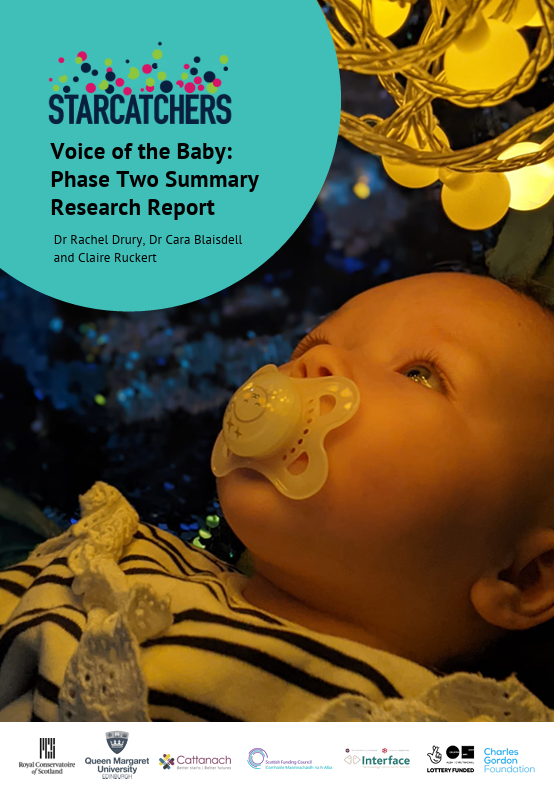
The Starcatchers Voice of the Baby project explored current and emerging rights-based approaches in the arts for babies and young children aged 0-3 in Scotland, with a focus on participation rights and creating an arts-based methodology for early years participation. The UN Convention on the Rights of the Child (1989) enshrines children’s right to express their views, on all matters affecting them, and to have those views given due weight (Article 12). Babies and young children are entitled to all the rights enshrined in the UNCRC—including the right to be heard—but in early childhood this right is often overlooked or neglected. Full implementation of Article 12 requires recognition and respect for both verbal and non-verbal communication, and the arts offer great potential for babies to exercise their right to be heard. Participation in cultural life and the arts is itself a right enshrined in the UNCRC (Article 31) and is connected to a longer human rights history–for example, the right to participate in the cultural life of the community is enshrined in Article 27 of the Universal Declaration of Human Rights (UDHR, 1948). The participation of babies and young children in artistic and cultural life is not only an opportunity for babies themselves, but also has the potential to develop and transform the societies in which they live. As Scotland moves toward incorporation of the UNCRC into Scots law, it is timely to investigate how the arts can enable babies and young children to exercise their right to be heard.
Phase One of the project (funded by Cattanach and Interface) investigated existing knowledge and best practice in this area, via a scoping review of peer-reviewed empirical research studies, a survey conducted with Scottish-based arts practitioners and arts organisations, and group interviews with Starcatchers staff and associate artists. In Phase Two, we visited three Starcatchers creative play projects to learn how artists support the participation rights of babies and young children in ‘real life’. Bringing together our learning from those visits with the findings from Phase One, we have constructed a flexible reflective guide for practitioners across sectors, who wish to facilitate rights based participatory practice with babies and young children through the creative arts.
Phase Two is centred around working with babies from birth who are pre-verbal or developing language skills, however, we recognise that the resulting Reflective Guide may well have a broader application with older children and young people who are nonverbal.
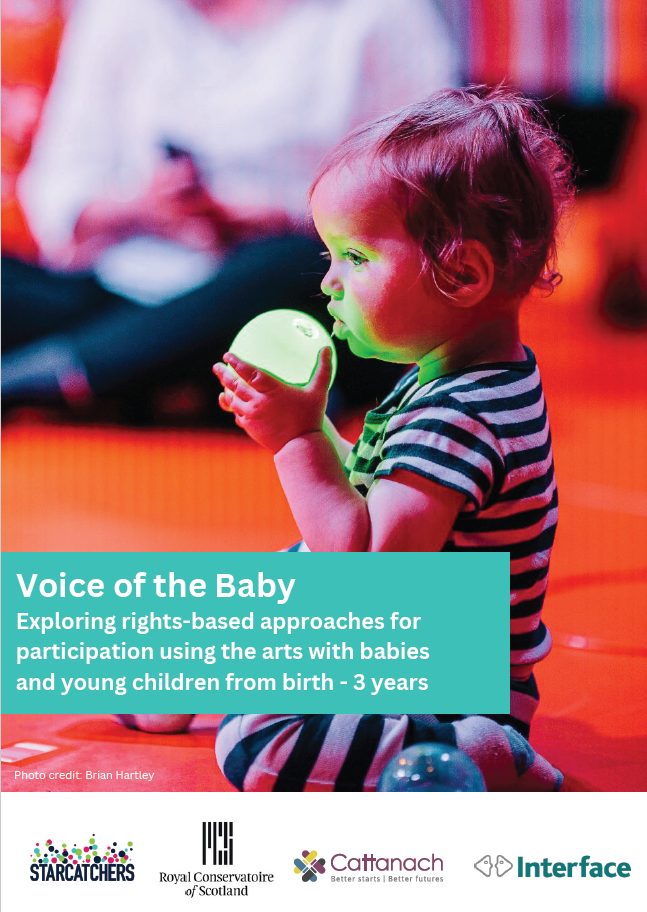
The United Nations Convention on the Rights of the Child (UNCRC) is currently being incorporated into domestic Law in Scotland. In the lead up to incorporation, and as implementation is rolled out, cross-sector organisations, statutory services and government bodies are acknowledging that we must listen to children and young people when it comes to matters that affect their lives; this also includes pre-and non-verbal children.
This Summary Research Report represents Phase 1 of a larger research project. The purpose of Phase 1 was to explore current and emerging rights-based approaches in the arts for children aged birth to 3 in Scotland, with a particular focus on pre- and/or non-verbal children in this age category. The findings from Phase 1 will contribute towards the development of a framework for participation specific to pre-and non-verbal children (Phase 2).
This research represents a partnership project between Starcatchers and the Royal Conservatoire of Scotland, with funding from Cattanach and Interface.
This article draws on case studies from Brazil, Denmark, Israel, Norway, and Nicaragua to analyse the outcomes of transformative participation in child welfare. Transformative participation occurs when children make meaningful choices, develop a sense of agency, possess the resources to exercise agency, and can make a real difference in their lives, their communities, and child welfare. Caring and inclusive attitudes, relationships, and practice approaches characterise transformative participatory professional practices. We demonstrate that transformative methods can create conditions so children feel recognised and empowered and empower themselves. They encourage children to collectively engage in actions to change cultural norms and develop new child welfare practice approaches and policies. We show how local-level practitioners in public and nongovernmental child welfare organisations can play a crucial role in fostering children’s transformative participation.

From the very beginning, the Creative Schools programme has aspired to hold youth voice at the centre. Back in 2017 and 2018 when the programme was being conceived and designed at the Arts Council the National Strategy on Children and Young People’s Participation in Decision-Making was an important touchstone. The Arts Council was already embodying a commitment to participation in decision making in many of its programme like the Young Ensembles Scheme and Creative Schools offered another route to centre children and young peoples’ opinions.
Once the programme was established and the first 150 schools began working with their Creative Associates, we benefited hugely from support and guidance from Hub na nÓg to embed this way of working. As the programme has grown, we have witnessed the growth in confidence, experience and curiosity about youth voice among our community.
Since 2018, the landscape around Creative Schools has changed. There is now increased understanding and very welcome higher expectations of how children and young people will be listened to. New national policies for children and young people are clear in how young people have been consulted and there have been greater than ever efforts to ensure all children and young people are included in participation.
This publication is an attempt to capture, celebrate and share ways of working, reflections, ideas, and challenges that have been part of the journey of many Creative Schools. The articles provide a snapshot of the hundreds of projects and programmes which have creatively raised children’s voices. Of course, consultation with children and young people has been a feature of arts in schools and arts in other places for a long time but the scale and reach of Creative schools since 2018 has given us this opportunity to bring together some examples of recent practice, which we offer to anyone with an interest in this area.

The Scottish Government is giving children’s rights the highest possible protection in Scotland by incorporating the United Nations Convention on the Rights of the Child (UNCRC) (1) into Scots law through the UNCRC (Incorporation) (Scotland) Act 2024 (2). Children’s rights are already central to law and policy in Scotland and progressing them is a key part of the roles of many workers. Incorporation of the UNCRC means there is a legal duty on public authorities and those carrying out public functions not to act in ways that are incompatible with the UNCRC requirements. The adoption and implementation of a children’s human rights approach will support workers in preparing for these new duties.
The framework has been designed to:
• Support individuals and organisations to adopt a children’s human rights approach.
• Improve and consolidate the workforce’s understanding of children’s rights and increase their confidence to implement the UNCRC in their everyday work.
• Set out the skills and knowledge the workforce will need to grow their children’s rights practice, and improve over time.
• Highlight useful resources for workers to engage with to further develop their skills and knowledge.
• Enable the necessary culture change to fully respect, protect and fulfil rights for children and young people in Scotland. Implementing a children’s human rights approach will build on existing best practice and support the realisation of other crucial policy objectives.
This review was commissioned by the Department for Children, Equality, Disability, Integration and Youth (DECDIY) to provide an up-to-date understanding of what children and young people who have experienced poverty have been asked about and consulted on, and to identify key methodological and ethical issues. The aim of the review is to provide practical guidance for researchers and practitioners who are contemplating involving children and young people living in poverty in a research project or a consultation. The involvement of children and young people in any research or consultation should be placed within the context of an international rights-based framework. The adoption of the UN Convention of the Rights of the Child specifies the right of all children to express an opinion on matters and decisions that affect them directly and to have that opinion taken into account. In the Irish context, there is now increasing emphasis on eliciting the views and perspectives of children and young people in matters that relate to them, and this is reflected in policy and practice whereby government and agencies of the state are increasingly advocating and drawing on children young people’s voice in research and consultation processes. More recently, the United Nations Committee on the Rights of the Child (UNCRC) has expressed serious concern about the large number of children in Ireland that are living in poverty, food insecurity and homelessness, and about the children of ethnic minority groups who do not have access to child benefit payments due to the habitual residence condition. In a recent report the Committee urged the Irish state to ensure that measures to combat poverty comply with a child rights-based approach and include a particular focus on children from disadvantaged families, especially children of single parents, refugee children and children of ethnic minority groups (UNCRC, 2023). This report contributes to supporting this task and includes a methodological and ethical review of how to capture the voices of vulnerable children, with a particular focus on experiences of children and young people living in poverty. The practical guidance offered in this report can inform future research initiatives and consultations that aim to better understand the lived experience and views of children and young people experiencing poverty.