Tag: Youth Voice

Photovoice Reimagined: A Guide to Supporting the Participation of Students With Intellectual Disabilities in Research

Article 12 of the United Nations Convention of the Rights of the Child (UNCRC) (1989) sets out the right for all children to be heard and for their opinions to be given due weight. However, the voices of children with disabilities often remain silenced as their perspectives are rarely consulted. This paper describes how a visual, participatory research method called Photovoice was used to elicit the voices of students with Intellectual Disabilities (ID) in mainstream post-primary schools in the Republic of Ireland. Thirteen students with ID in four schools across Ireland participated by taking photographs of aspects of their school life that were meaningful to them. Photographs focused on places, spaces, objects and examples of learning, including their role in decision making. This paper details the stages of the Photovoice method which was adapted to support students to participate in the research process. It provides guidance on how to address the ethical and methodological concerns which arise when researching with children. It outlines a two-step approach to analysis, where participating students interpreted and created meaning which was further developed by the Principal Investigator. Employing Photovoice repositions students in this study as co-researchers and co-creators of meaning. Its use operationalises Lundy’s Model of Participation (2007) by providing space, voice, audience and influence which are necessary for children to express their views and have their voices heard in an ethical and inclusive manner.

Lundy Model Resources

The “Lundy model” has been adopted by numerous national governments and public bodies as well as international organisations including the World Health Organisation, European Commission, Council of Europe, UNICEF, World Vision. Its key proponent has been the Irish Government, first in the National Strategy on Child and Youth Participation and from 2021 in its National Framework on Child and Youth Participation. Working through its national centre for excellence, Hub Na nOG, Laura worked with it to develop a series of tools based on the Lundy Model that are widely used in Ireland and have been translated, adapted and adopted globally.

Lundy Model Squared

One of the ironies of the Lundy Model, like the UNCRC itself, is that an approach that advocates for children’s right to be heard did not involve children when it was created. While it was inspired by and based in part, on a study that included the views and experiences of over 1000 children, the conceptual framework for Article 12 of the UNCRC was written by one adult – me. Of course, my focus at that time was on promoting better understanding among adult duty-bearers rather than children. So, it has been deeply gratifying that, over the years, so many children and young people have taken the model and made it their own which in turn – not surprisingly – has strengthened our understanding of child and youth participation. For me, that’s the Lundy Model squared.

Below I set out some examples. But first, I start with a speech that was given by Tash (then 17 and a member of Leicester City Council’s Care-Experienced Council) at the launch of Leicester’s ground-breaking participation strategy. When it was sent to me by Bez Martin, I had goosebumps when reading it since Tash captured what it is all about so succinctly and powerfully.

Youth Voice and Participation Handbook

Sound Connections has been experimenting with Youth Voice & Participation since 2008. We were inspired by research produced by the Participation Works consortium, partnership founded to further understanding and practice of youth voice, particularly across the voluntary youth sector. We were especially influenced by the milestone report, Building a Culture of Participation (Kirby et al., 2003) the findings of which we began to test and implement in our youth voice and leadership programme, Wired for Music.

Over the years, we’ve learnt about the profound impact a youth voice approach can have on practice, people, planning and policies. Quite simply, we are not the same organisation we were ten years ago. Today, young people are integral to how Sound Connections operates: they shape our programmes, produce their own events, advise us on funding decisions and sit on our board. They also play a key role in our work advocating for youth voice practice across the creative and cultural sector, especially the consultancy we provide to other organisations looking to learn more about youth voice and embed it in their programmes and strategies. It has been an eye-opening and transformational journey, and one that we want to share as widely as possible.

And that’s why we’ve created this handbook. As far as we know, to date, no-one has attempted to produce a guide to youth voice for the creative and cultural sector. This handbook is for you if you or your organisation work creatively with young people. You might work in arts, culture or heritage, in a youth work or educational setting, or in another sector where creative engagement is enhancing the lives of young people. We are delighted to launch the Youth Voice & Participation Handbook and we hope that you will find it informative, intriguing and inspiring.

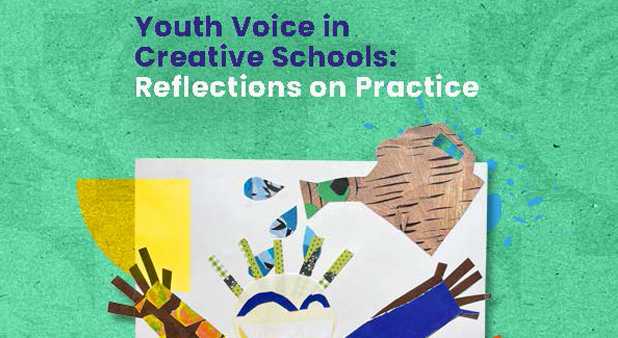
Youth Voice in Creative Schools: Reflections on Practice

From the very beginning, the Creative Schools programme has aspired to hold youth voice at the centre. Back in 2017 and 2018 when the programme was being conceived and designed at the Arts Council the National Strategy on Children and Young People’s Participation in Decision-Making was an important touchstone. The Arts Council was already embodying a commitment to participation in decision making in many of its programme like the Young Ensembles Scheme and Creative Schools offered another route to centre children and young peoples’ opinions.

Once the programme was established and the first 150 schools began working with their Creative Associates, we benefited hugely from support and guidance from Hub na nÓg to embed this way of working. As the programme has grown, we have witnessed the growth in confidence, experience and curiosity about youth voice among our community.

Since 2018, the landscape around Creative Schools has changed. There is now increased understanding and very welcome higher expectations of how children and young people will be listened to. New national policies for children and young people are clear in how young people have been consulted and there have been greater than ever efforts to ensure all children and young people are included in participation.

This publication is an attempt to capture, celebrate and share ways of working, reflections, ideas, and challenges that have been part of the journey of many Creative Schools. The articles provide a snapshot of the hundreds of projects and programmes which have creatively raised children’s voices. Of course, consultation with children and young people has been a feature of arts in schools and arts in other places for a long time but the scale and reach of Creative schools since 2018 has given us this opportunity to bring together some examples of recent practice, which we offer to anyone with an interest in this area.

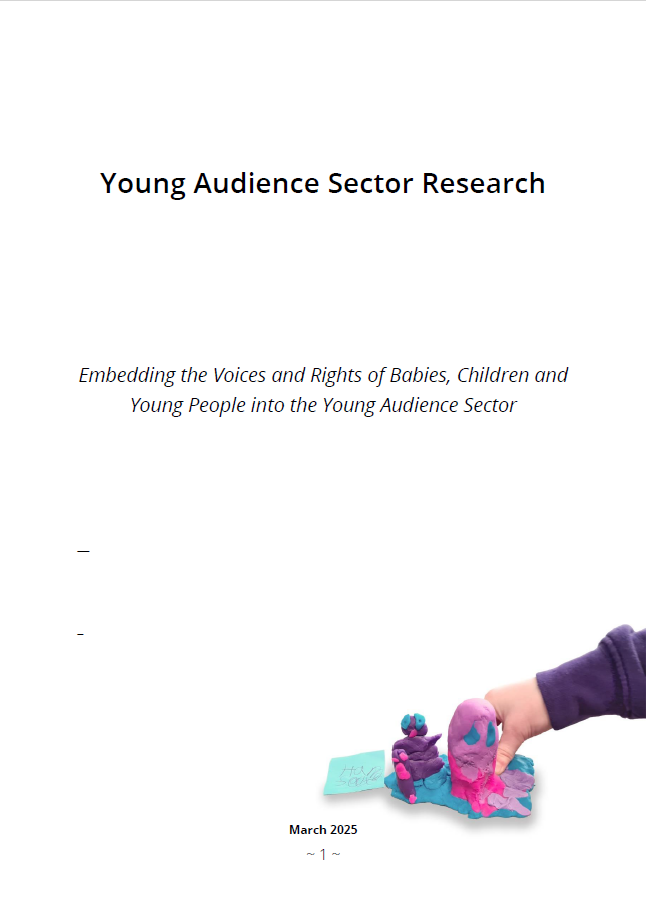
Young Audience Sector Research: Embedding the Voices and Rights of Babies, Children and Young People in the Young Audience Sector

This research was commissioned by the Young Audience Group and funded by Creative Scotland. The Young Audience Group is a collective of organisations and freelancers who have been meeting informally since 2018 to advocate for and raise awareness of the young audience sector. The collective is currently comprised of the following organisations and individuals: Action Boat, Barrowland Ballet, Catherine Wheels & Shona Reppe, Curious Seed, Frozen Charlotte, Imaginate, Independent Arts Projects, Lyra, Scottish Theatre Producers, Starcatchers and Visible Fictions. In 2021, research carried out by Cultural Radar identified key needs and priorities for the Young Audience Group’s ongoing work. Victoria Beesley led a second phase of research in 2023 exploring what a new network/ membership collective of freelancers and organisations working in the young audience sector might look like. This third phase of research is focused on two different elements: equity and access in a membership collective for the young audience sector – this research has been carried out by Kirstin Georgia Abraham; and the voices and rights of babies, children and young people within a membership collective for the young audience sector – this research has been carried out by Victoria Beesley and is the focus of this report.

Youth Voice in Creative Schools: Reflections on Practice

This publication is an attempt to capture, celebrate and share ways of working, reflections, ideas, and challenges that have been part of the journey of many Creative Schools. The articles provide a snapshot of the hundreds of projects and programmes which have creatively raised children’s voices. Of course, consultation with children and young people has been a feature of arts in schools and arts in other places for a long time but the scale and reach of Creative schools since 2018 has given us this opportunity to bring together some examples of recent practice, which we offer to anyone with an interest in this area. 

Participation in Practice in Child Welfare: Processes, Benefits and Challenges

Internationally, there has been a significant focus in policy and practice on the participation of children and young people in decisions that affect them, underpinned by respect for their rights under Article 12 of the UNCRC. While children’s participation has become a core focus for practice improvement in child welfare services, there is a dearth of practical examples of how participation is implemented in organisations. In this paper, we provide a reflective case study of participation in practice in the Youth Advocate Programme (YAP) in Ireland, a large non-profit child welfare organisation. YAP Ireland works with young people who are considered ‘high risk’ using a strength-based approach in a wraparound service that is family-driven and youth-guided. Drawing on qualitative interviews and focus groups with young people, parents, advocates, and staff and management, we describe and critically analyse YAP’s approach to participation. Critical factors in practice include a commitment to participation in policy, practice and culture at all levels of the organisation and scaffolding of participation by staff. Challenges include ensuring that participation principles are upheld consistently across the organisation and resourcing participation.