Tag: Participation

OCO Beyond Limits Accessible Event Guide

Who we are The Ombudsman for Children’s Office (OCO) is a human rights institution that promotes the rights and welfare of young people under 18 years of age living in Ireland. The OCO also investigates complaints about services provided to children by public organisations. The service is free and independent.

Introduction

The Ombudsman for Children’s Office hosted Beyond Limits, an event for children with disabilities, in 2019 and 2022. Beyond Limits is a family event made up of talks, entertainment and activities that include disabled children in the line-up and that they can take part in. Beyond Limits was designed to be fully accessible and inclusive. This means that all children should be able to attend and take part.

Over 2,000 people have attended Beyond Limits events. In 2019 Beyond Limits took place in Croke Park and in 2022 there were events in both Sligo and Limerick. In 2022 a Beyond Limits Youth Advisory Panel (YAP) was established to help plan and organise the events. The YAP was made up of eight amazing young people of all abilities from different parts of the country.

Beyond Limits is a special space where disabled children and their families do not feel different. They do not have to do the same preparation to attend, they do not need to worry about whether the supports they need will be available and they do not need to consider if children will disrupt what is going on.

In organising three Beyond Limits events we discovered that there is no centralised resource available (that we could find) to help organise a fully accessible and inclusive event. In order to make Beyond Limits happen we consulted with a range of organisations and we had the input of our YAP who experience barriers to participation and attendance every day.

Making an event accessible and inclusive should not be an added extra. This Accessible and Inclusive Event Guide has been created to bring together all of our learnings and to help other organisations and businesses to do better for disabled children and adults. 

Children and Young People’s Participation in Child Protection: Outcomes of Transformative Participation in International Contexts

This article draws on case studies from Brazil, Denmark, Israel, Norway, and Nicaragua to analyse the outcomes of transformative participation in child welfare. Transformative participation occurs when children make meaningful choices, develop a sense of agency, possess the resources to exercise agency, and can make a real difference in their lives, their communities, and child welfare. Caring and inclusive attitudes, relationships, and practice approaches characterise transformative participatory professional practices. We demonstrate that transformative methods can create conditions so children feel recognised and empowered and empower themselves. They encourage children to collectively engage in actions to change cultural norms and develop new child welfare practice approaches and policies. We show how local-level practitioners in public and nongovernmental child welfare organisations can play a crucial role in fostering children’s transformative participation.

Progressing Children’s Right to be Heard in Public Decision-making: Perspectives on Using Social and Digital Media to Facilitate Children’s Participation

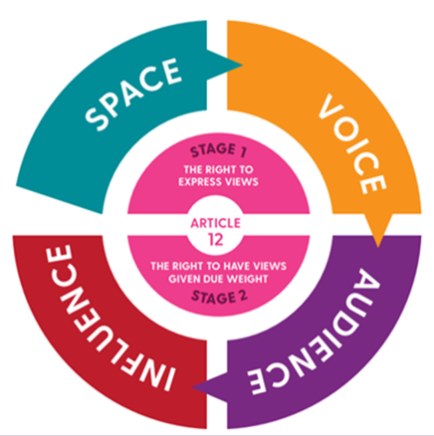
Children’s right to be heard is expressed in Article 12 of the U.N. Convention on the Rights of the Child. Mechanisms and methods to facilitate the inclusion of young people’s views have been developed by youth workers, advocates and policy-makers and include diverse consultation approaches, including surveys, polls, consultation meetings and formal structures such as youth parliaments. Even though social and digital media are now pervasive in the lives of children, the potential to use these as tools to facilitate youth consultation is still surprisingly at an early stage of development. This paper presents findings from a national mixed-method study on how digital technologies might be further harnessed for this purpose. Over 300 children (6 to 17 years) and 30 professional stakeholders from government departments, public agencies, industry and civil society were consulted regarding their experiences and attitudes towards facilitating children’s participation through social and digital media. While children and young people generally expressed optimism about their potential, professional stakeholders held varying opinions regarding the pros and cons of utilizing digital tools. This paper highlights the contours of this sometimes contentious debate over the appropriate balance to be struck between protection and participation in using digital technologies and taking into consideration children’s best interests in realising their right to be heard. Drawing on the findings, we present a set of principles to guide the future deployment of social and digital media to facilitate children’s participation in public decision-making.

A Literature Review on Best Practices and International Comparisons for Participation in Decision-making of Children Aged 6-12

This Literature Review on best practices and international comparisons for the participation of children aged 6- 12 (Action 5.1.1) is being undertaken as part of broader work including a report on a consultation process on the participation of children under 12 (Action 5.1.2) to deliver the aims of the Comhairle na nÓg Five-Year Development Plan to explore participation structures for children under 12.

The inclusion and active involvement of children in public and civic participation is a critical aspect of fostering a democratic and inclusive society. Children’s right to participate in decisions that impact their lives has received growing recognition since the ratification of the United Nations Convention on the Rights of the Child (UNCRC). The literature suggests that children’s participation is a complex and multifaceted concept, involving various levels of involvement, contexts, and activities (Alanko, 2019). Despite an extensive growth in the literature on all aspects of children and young people’s participation it is notable that children between the ages of 6-12 remain relatively absent from this body of work.

This review focuses on children aged 6-12 years and how they can be included in collective decision-making processes and included in the processes of policy formation through formal and public decision-making participation structures. A previous review for the Department of Children, Equality, Disability, Integration and Youth (DCEDIY) and Hub na nÓg (Horgan, 2024) examined consultation with children from birth to five years. McCall-Smith (2023) stresses that the distinction between personal and collective decision-making is important in relation to “assessing when the views of a child, either individually or as part of a group, should be sought and how to facilitate this exchange of views” (McCall-Smith, 2023, p.1183).

Although definitions vary, middle childhood is most often understood as the period lasting from 6 – 12 years (Bhana, 2010). Middle childhood is a ‘key transitional childhood period’ (Campbell, 2011). Lancy and Grove (2011) provide ethnographic evidence across a variety of cultures in support of middle childhood as a universal developmental period in which children make a great effort to enter the public arena. Similarly, Jones and Cunningham (2005, p.41) refer to children’s expanding worlds in the period of middle childhood where ‘the child’s independent territorial range expands, accompanied by an increasing ability to interpret the physical and social world and to create new worlds in the imagination’. Peers become more important in children’s lives, and they take a more active role in shaping the nature of their play and activities. Middle childhood is also an important period for developing social and cognitive skills and for children’s emerging self-concept (McNamara et al., 2021). Childhood well-being and happiness studies indicate that the period of middle childhood is where children self-report as being at their happiest (Gavin et al., 2022).

In policy terms, middle childhood is dominated by education (Bessell et al., 2024). It is the institution where children spend most of their time when not at home. Schools, and adults in schools, are centrally important and can have a powerful impact on children during the middle childhood phase. In their work on the multiple contexts of middle childhood, Coll and Szalacha (2004), identify both school and community facilities as the most critical resources in middle childhood. However, the institutionalised nature of childhood means that there are few pathways for children to actively take part in social and civic activities outside of school, and so, ‘we need to reduce the reliance on schools as the dominant or sole institution responsible for supporting children’s participation or providing intergenerational relationships’ (Bessell et al., 2024). The report is organised in the following way: a brief summary of the methodological approach to the literature review, followed by a discussion of the conceptualisation and influences on child participation. The types of formal participatory activity for children under 12 are detailed as well as some innovative international structures and practices, and strategies supporting participation. The report concludes with some recommendations for developing effective and age- appropriate structures for children under 12.

Youth Voice in Creative Schools: Reflections on Practice

This publication is an attempt to capture, celebrate and share ways of working, reflections, ideas, and challenges that have been part of the journey of many Creative Schools. The articles provide a snapshot of the hundreds of projects and programmes which have creatively raised children’s voices. Of course, consultation with children and young people has been a feature of arts in schools and arts in other places for a long time but the scale and reach of Creative schools since 2018 has given us this opportunity to bring together some examples of recent practice, which we offer to anyone with an interest in this area. 

Participation in Practice in Child Welfare: Processes, Benefits and Challenges

Internationally, there has been a significant focus in policy and practice on the participation of children and young people in decisions that affect them, underpinned by respect for their rights under Article 12 of the UNCRC. While children’s participation has become a core focus for practice improvement in child welfare services, there is a dearth of practical examples of how participation is implemented in organisations. In this paper, we provide a reflective case study of participation in practice in the Youth Advocate Programme (YAP) in Ireland, a large non-profit child welfare organisation. YAP Ireland works with young people who are considered ‘high risk’ using a strength-based approach in a wraparound service that is family-driven and youth-guided. Drawing on qualitative interviews and focus groups with young people, parents, advocates, and staff and management, we describe and critically analyse YAP’s approach to participation. Critical factors in practice include a commitment to participation in policy, practice and culture at all levels of the organisation and scaffolding of participation by staff. Challenges include ensuring that participation principles are upheld consistently across the organisation and resourcing participation.