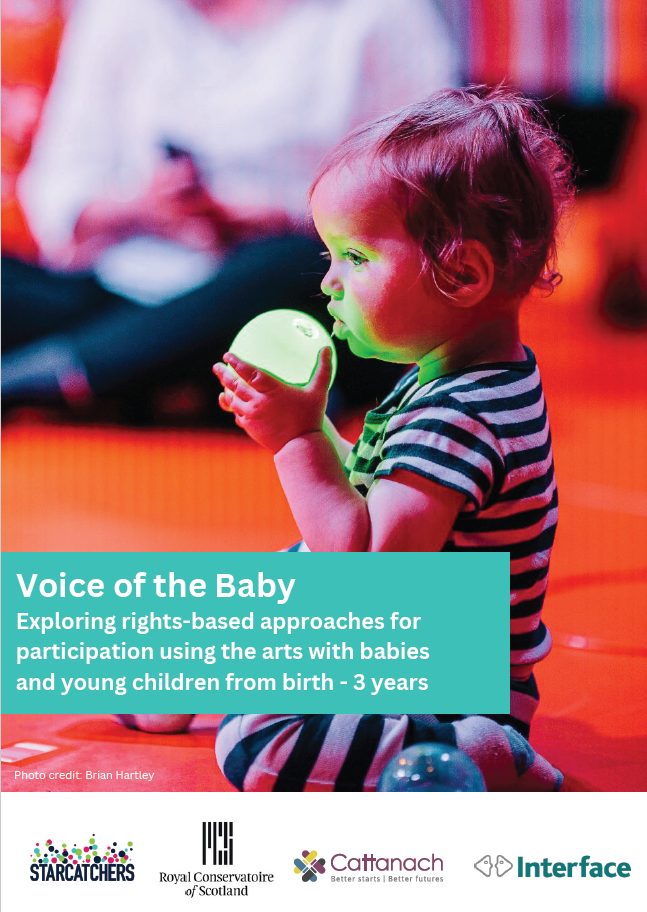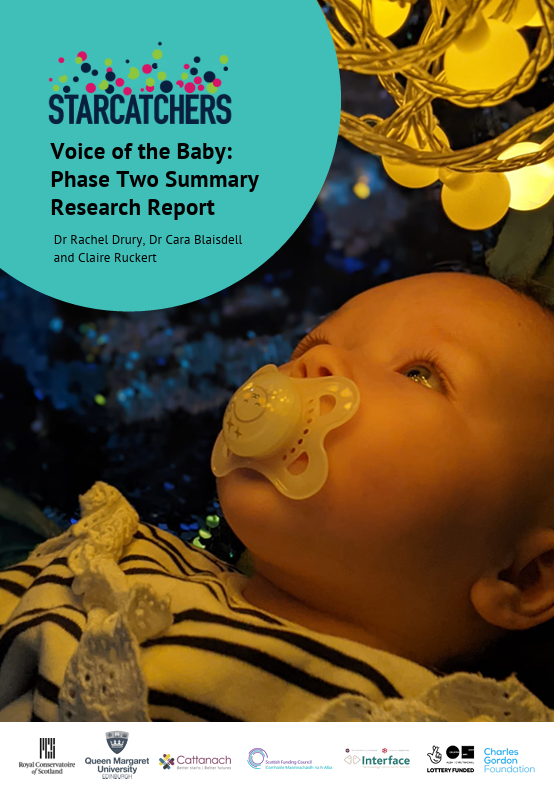
Voice of the Baby: Research Summary Reports Phase 2
The Starcatchers Voice of the Baby project explored current and emerging rights-based approaches in the arts for babies and young children aged 0-3 in Scotland, with a focus on participation rights and creating an arts-based methodology for early years participation. The UN Convention on the Rights of the Child (1989) enshrines children’s right to express their views, on all matters affecting them, and to have those views given due weight (Article 12). Babies and young children are entitled to all the rights enshrined in the UNCRC—including the right to be heard—but in early childhood this right is often overlooked or neglected. Full implementation of Article 12 requires recognition and respect for both verbal and non-verbal communication, and the arts offer great potential for babies to exercise their right to be heard. Participation in cultural life and the arts is itself a right enshrined in the UNCRC (Article 31) and is connected to a longer human rights history–for example, the right to participate in the cultural life of the community is enshrined in Article 27 of the Universal Declaration of Human Rights (UDHR, 1948). The participation of babies and young children in artistic and cultural life is not only an opportunity for babies themselves, but also has the potential to develop and transform the societies in which they live. As Scotland moves toward incorporation of the UNCRC into Scots law, it is timely to investigate how the arts can enable babies and young children to exercise their right to be heard.
Phase One of the project (funded by Cattanach and Interface) investigated existing knowledge and best practice in this area, via a scoping review of peer-reviewed empirical research studies, a survey conducted with Scottish-based arts practitioners and arts organisations, and group interviews with Starcatchers staff and associate artists. In Phase Two, we visited three Starcatchers creative play projects to learn how artists support the participation rights of babies and young children in ‘real life’. Bringing together our learning from those visits with the findings from Phase One, we have constructed a flexible reflective guide for practitioners across sectors, who wish to facilitate rights based participatory practice with babies and young children through the creative arts.
Phase Two is centred around working with babies from birth who are pre-verbal or developing language skills, however, we recognise that the resulting Reflective Guide may well have a broader application with older children and young people who are nonverbal.