Topic: Children

Child-Friendly Justice Assessment Tool

This Child-Friendly Justice (CFJ) Assessment Tool aims to support member states in meeting the standards for child-friendly justice in all situations in  which children are likely to be brought into contact with the justice system, for whatever reason and in whatever capacity – as offenders, victims, witnesses or parties – in judicial proceedings (criminal, civil or administrative law) or non- judicial proceedings. The Assessment Tool is intended to assist member states in best implementing the Guidelines of the Committee of Ministers of the Council of Europe on Child-friendly Justice (hereinafter referred to as ‘the Guidelines’) and in best self-assessing their progress in doing so.

Guide to Children’s Participation in Decisions About Their Health

The Guide provides information and advice, primarily for healthcare professionals, about how to involve children in decision-making processes regarding their health. It starts by presenting the theoretical and legal context and progresses to describe important components of the decision-making process, helping health professionals to understand their role in supporting children, families, and other professionals to enact this in practice. Key concepts of consent, assent, and ‘best interests’ are discussed, as well as common healthcare situations where participation in decision-making may sometimes be perceived as more challenging. Examples and links to good practice are provided throughout.

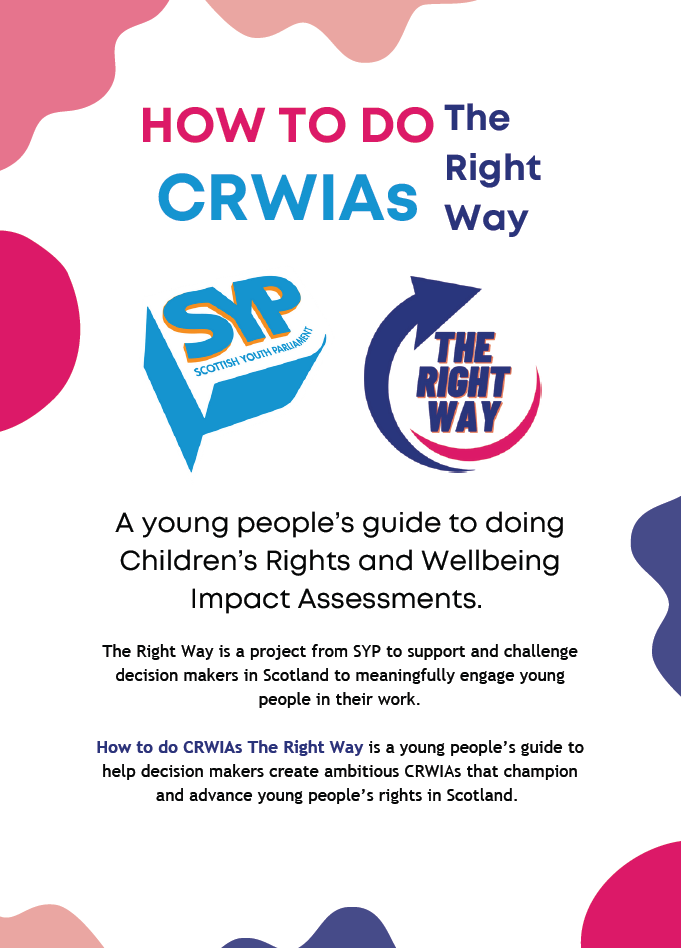
How to do the CRWIAs The Right Way – A young people’s guide to doing Children’s Rights and Wellbeing Impact Assessments

The Right Way is a project from SYP to support and challenge decision makers in Scotland to meaningfully engage young people in their work. How to do CRWIAs The Right Way is a young people’s guide to help decision makers create ambitious CRWIAs that champion and advance young people’s rights in Scotland.

Children’s Rights in Brief #3 – Respect for the Views of the Child

The Ombudsman for Children’s Office (OCO) is an independent statutory body, which was established in 2004 under the Ombudsman for Children Act 2002 (2002 Act). Under the 2002 Act, as amended, the OCO has two core statutory functions:

to promote the rights and welfare of children up to 18 years of age; and
to examine and investigate complaints made by or for children about the administrative actions of public bodies, schools and voluntary hospitals that have, or may have, adversely affected a child.

This briefing is third in a series that the OCO is producing to raise awareness of children’s rights under the United Nations Convention on the Rights of the Child (UNCRC).1 We are creating this series in line with our duties:

to encourage public bodies to develop policies, practices and procedures designed to promote the rights and welfare of children (section 7(1)(b) of the 2002 Act); and
to collect and disseminate information on matters relating to children’s rights and welfare (section 7(1)(c) of the 2002 Act).